
How to Budget for High-Efficiency Furnace Installation in 2025
A high-efficiency furnace is a heating appliance engineered to convert a larger share of fuel into usable heat, typically measured by AFUE (Annual Fuel Utilization Efficiency), and installed systems in 2025 commonly range from mid four-figures to low five-figures depending on options. This guide explains the components of high efficiency furnace cost, how AFUE and fuel type drive price, and where labor, ductwork, and incentives change net outlay. Homeowners face uncertainty about unit prices, installation complexity, and available rebates when planning a replacement, and this article maps real budgeting scenarios so you can request an accurate proposal. You will learn average installed cost ranges, a unit-versus-installed cost table, the major price drivers, how federal and local incentives affect net cost, and a step-by-step view of installation and maintenance. With those elements clarified, you can compare options, estimate payback periods, and prepare the home details contractors will need to produce an accurate estimate.
What Is the Average Cost to Install a High Efficiency Furnace in 2025?
High-efficiency furnace installation cost reflects the unit price plus installation labor, materials, permits and any required duct or vent upgrades; typical installed ranges in 2025 span the lower thousands for modest gas replacements to the upper range for large homes with complex ductwork. These systems achieve higher AFUE ratings—90–98%+—and higher AFUE generally correlates with higher unit cost and sometimes modestly higher installation complexity due to condensing venting and condensate handling. The first table below compares representative unit-only price ranges and installed cost ranges across common AFUE tiers and fuel types to help homeowners visualize budget bands. Understanding the split between unit price and installed cost clarifies where savings from rebates or efficient sizing can materially reduce the out-of-pocket amount.
| Furnace Type & AFUE | Typical Unit Price | Typical Installed Cost |
|---|---|---|
| Gas furnace, 90–92% AFUE | $900 – $2,000 | $3,500 – $6,000 |
| Gas condensing, 95% AFUE+ | $1,800 – $3,500 | $5,000 – $8,500 |
| High-end modulating gas, 98%+ AFUE | $2,500 – $4,500 | $7,000 – $11,000 |
| Electric high-efficiency (all-electric homes) | $1,200 – $3,000 | $3,500 – $7,000 |
This table demonstrates the relationship between unit-only price and installed cost; installed totals reflect labor, venting, ductwork, and permit variables that the next subsection breaks down further.
What Are Typical Unit Prices for High Efficiency Furnaces by AFUE and Fuel Type?
Unit-only price depends on AFUE, fuel type, and feature set; higher AFUE and advanced staging or modulating burners raise factory pricing. Gas furnaces at mid-range AFUE are generally the most common and offer a broad price band due to different brand tiers and blower technologies. Electric high-efficiency units and specialized condensing gas models trend higher on a unit basis because of additional components like stainless-steel heat exchangers, modulating gas valves, or enhanced control boards. When planning, separate the manufacturer list price from expected installed cost so you can see how contractor labor and additional parts drive the final invoice.
Higher-AFUE units often include extra components that affect price and installation:
- Variable-speed blowers and ECM motors increase unit cost and lower operating expense.
- Modulating gas valves or two-stage burners add precision (and cost) to combustion control.
- Condensing designs require corrosion-resistant materials and condensate handling equipment.
These component differences explain why two furnaces with similar heating capacities can differ substantially in both unit price and installed cost.
How Much Do Labor and Additional Installation Fees Usually Cost?
Labor and on-site installation fees commonly represent a substantial portion of the installed cost, with typical labor ranges influenced by regional rates, installer expertise, and job complexity. Standard residential replacements often see labor and basic hookup in a moderate range, while jobs that require new venting, significant duct modification, or gas-line upgrades push labor costs higher. Additionally, permit fees, disposal of the old unit, and small-materials charges add predictable line items that should appear on any detailed estimate. The following list outlines the most common add-on charges and typical ranges to expect when reviewing contractor bids.
Common installation add-ons and typical ranges:
- Labor and basic hookup: $1,000–$3,000 depending on complexity and locale.
- Ductwork repairs or enhancements: $500–$2,000+ for sealing, re-routing, or new trunk sections.
- Venting and condensate installation (for condensing furnaces): $200–$1,000 for PVC runs and condensate traps.
- Permit and inspection fees: $50–$300 depending on municipality requirements.
- Thermostat upgrade or smart control wiring: $100–$500 if rewiring or new controls are needed.
Which Factors Most Influence High Efficiency Furnace Installation Costs?
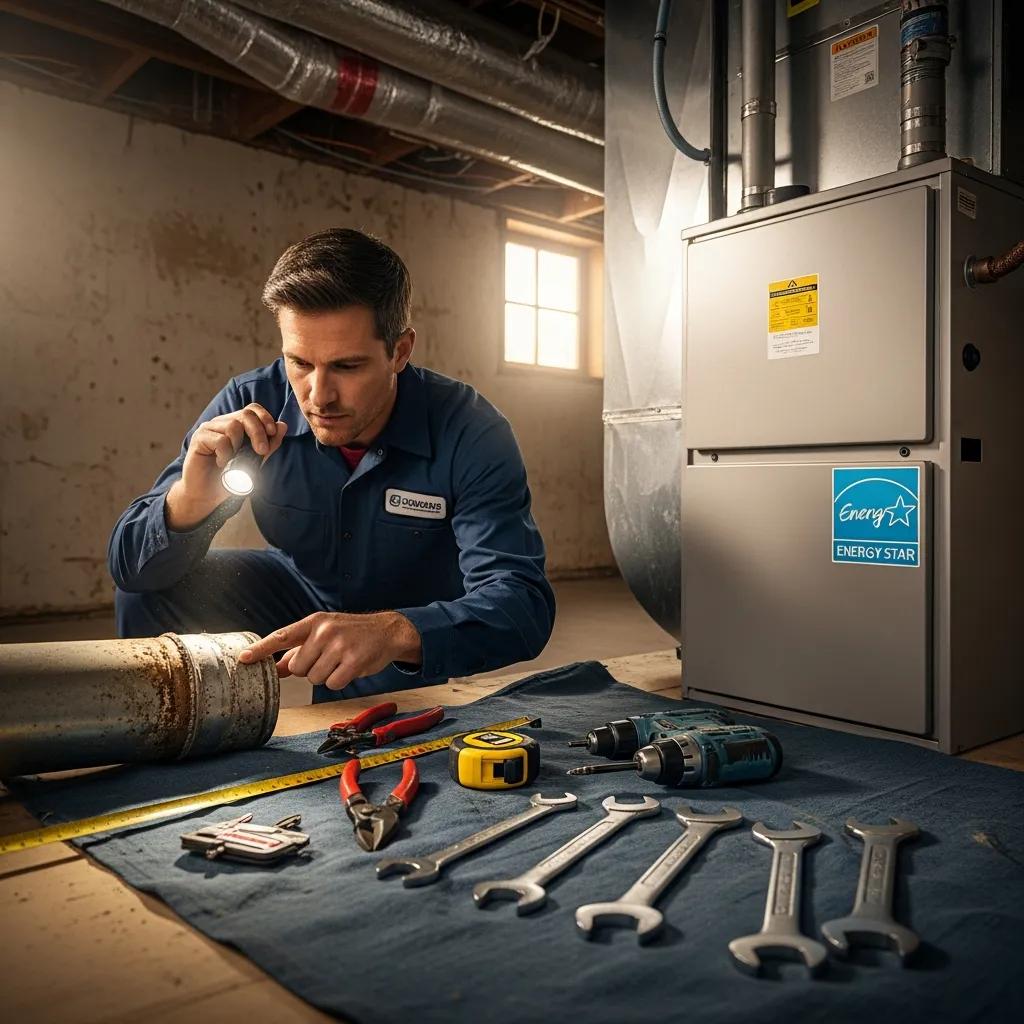
Several interacting factors set the final installed price of a high efficiency furnace, ranging from the selected AFUE and fuel type to the home’s ductwork condition and local labor rates. Furnace capacity, measured in BTU output, must match the home’s calculated heat load rather than raw square footage, and mis-sizing creates both comfort problems and unexpected cost. Installation complexity—such as switching from non-condensing to condensing vent systems, adding condensate drains, or upgrading gas piping—increases both materials and labor. Finally, brand, warranty, and added controls like zoning or variable-speed blowers push the equipment cost upward but also influence long-term operating expense and comfort.
| Cost Factor | Typical Range / Impact | How it Affects Total Cost |
|---|---|---|
| Furnace size (BTU) | Small to large capacities | Larger BTU units cost more and may require duct upgrades |
| Ductwork condition | Minor to major repairs | Extensive repairs add hundreds to thousands to install |
| Venting type | Standard vs. PVC condensing vent | Condensing venting adds materials and labor cost |
| Electrical/gas upgrades | Minor tweaks to full upgrades | Upgrades increase labor and permit fees significantly |
| Advanced features (modulating/variable-speed) | Mid to high equipment premium | Raises unit price but improves efficiency and comfort |
How Does Furnace Size and BTU Rating Affect Your Budget?
Furnace capacity must be chosen based on a professional heat-load calculation, which considers insulation, windows, orientation, and climate rather than square footage alone; selecting the right BTU rating prevents oversizing and inefficient cycling. Larger-BTU units cost more in both equipment and installation and may require larger ducts or additional circulation components, which increase labor and material costs. Conversely, undersized systems can lead to frequent cycling, higher operating costs, and the need for early replacement—so initial investment in accurate sizing can save money over the system’s life. The next subsection explains how brand and advanced features alter the upfront price and long-term value.
Choosing capacity correctly avoids future expenses and supports the projected payback period on a high-efficiency investment.
What Impact Do Brand, Features, and Installation Complexity Have on Price?
Brand reputation and product features such as modulating gas valves, variable-speed blowers, extended warranties, and advanced controls affect both the unit price and the expected performance benefits. Premium brands often price higher but may include better warranties or parts that reduce lifecycle costs; advanced features increase upfront cost but can cut fuel use and enhance comfort, influencing payback. Complex installations—such as converting fuel type, installing multi-zone controls, or making major structural duct changes—require more skilled labor and longer site time, multiplying labor charges. Evaluating the added comfort and efficiency benefits against the upfront premium helps determine whether higher-priced options deliver acceptable payback for your situation.
- Brand premium: Higher initial cost with potential reliability and warranty benefits.
- Advanced features: Greater efficiency and comfort at higher unit price.
- Complex installs: Skilled labor and time add to total invoice and can extend timelines.
These trade-offs should guide selection when comparing contractor proposals, balancing immediate budget constraints with long-term operating cost reductions.
How Can Federal and Local Rebates Reduce Your High Efficiency Furnace Costs?
Federal and local incentives in 2025 can materially reduce your net outlay for a high-efficiency furnace, but eligibility, program structures, and amounts vary considerably by taxpayer status and regional utility programs. A federal tax credit or rebate program may apply for qualifying equipment that meets specified efficiency criteria, and many utilities and state energy offices run supplemental rebates keyed to ENERGY STAR or certified product lists. Claiming incentives requires documentation such as manufacturer certificates, receipts, and installation records; filing processes differ between tax credits (claimed on tax returns) and point-of-sale utility rebates (applied during purchase or after installation). The table below summarizes common incentive types and the basic steps to claim them so you can factor potential savings into your budget.
| Incentive Type | Eligibility / Max Amount | How to Claim / Documentation |
|---|---|---|
| Federal tax credit | Varies; subject to IRS rules; up to $150 per furnace | Retain receipts and manufacturer certification; claim on tax return |
| State energy programs | Varies by state and year | Check state energy office guidance and submit required forms |
| Utility rebates | Varies by utility; often product-specific | Apply via utility program portal or submit post-install paperwork |
| Manufacturer promotions | Limited-time offers | Present invoice and product serials to qualify |
This reference helps you prioritize which incentives to research before requesting estimates and illustrates why net cost can be substantially lower than sticker price in many cases.
When rebates and credits are part of the decision, homeowners often want a personalized savings estimate tied to their specific home and chosen equipment. For a tailored rebate and net-cost calculation, please Convert to Quotes and submit your home details—such as square footage, current fuel type, and desired AFUE—so an installer or estimator can produce an accurate, incentive-adjusted quote that reflects federal and local programs.
What Federal Tax Credits Are Available for High Efficiency Furnace Installation in 2025?
Federal tax credits for energy-efficient heating equipment in 2025 are administered under the Inflation Reduction Act provisions and typically require equipment to meet defined efficiency and certification criteria such as ENERGY STAR specifications; eligibility hinges on taxpayer status and the product’s listed qualifications. Taxpayers can receive up to $150 in non-refundable tax credits for qualifying natural gas, propane, or oil furnaces or boilers meeting 95% AFUE or higher. To claim any federal credit, homeowners should keep manufacturer certification statements, detailed invoices, and documentation of the installation date and installer credentials. The IRS provides authoritative guidance on how to report and claim credits on your tax return, while ENERGY STAR and Department of Energy resources can confirm which models qualify for specific incentives. Before relying on a projected credit for budgeting, verify current IRS rules and consult a tax professional to confirm eligibility based on your specific situation.
Maintaining complete paperwork ensures that any federal credit can be claimed without delay and that an accurate net-cost figure appears on your financial planning.
How Do State and Utility Rebates Work to Lower Your Upfront Expenses?
State and utility rebates are highly variable: some utilities offer point-of-sale discounts, others provide mail-in rebates after installation, and state programs may have tiered incentives for qualifying products or households with income-based eligibility. To apply, consumers typically find program details on their utility or state energy office pages, confirm model eligibility, and complete either an online application or mail-in forms with installation proof and product certifications. Because timing and funds availability differ, it’s important to confirm rebate timelines—some programs operate on a first-come, first-served basis and require pre-approval before purchase. Combining utility rebates with federal credits often provides the most favorable net cost, but each program’s rules determine stacking potential.
A careful pre-purchase check of local program rules maximizes savings and prevents delays in claiming available funds.
Is Upgrading to a High Efficiency Furnace Worth the Extra Cost?
Yes — in many situations upgrading to a high efficiency furnace is worth the extra upfront cost because it reduces annual fuel use, improves comfort, and lowers emissions; the value proposition depends on climate, fuel prices, current system AFUE, and available incentives. Typical annual energy savings from upgrading an old low-AFUE furnace to a modern 95%+ model often fall in a range that translates to meaningful dollar savings over time, particularly in cold climates with long heating seasons. Evaluating payback requires comparing the incremental installed cost against projected annual savings and factoring in rebates, tax credits, and expected equipment lifespan. The next subsections quantify energy savings and show sample payback scenarios that homeowners can adapt to their local fuel costs and climate.
Consider the following when weighing the decision: current fuel price trends, expected system lifespan, and non-monetary benefits like improved comfort and quieter operation.
How Do High Efficiency Furnaces Compare to Standard Models in Energy Savings?
High-efficiency furnaces deliver higher AFUE ratings, which directly reduce the fraction of fuel wasted by combustion and heat transfer losses, so energy consumption for the same heating load typically falls by a meaningful percentage compared with older or standard-efficiency units. For example, moving from a 70% AFUE system to a 95% AFUE unit reduces fuel consumption proportionally for a given delivered heat load, although real-world savings vary with climate, thermostat settings, and building envelope performance. Other factors such as variable-speed blowers and improved airflow management also enhance effective system efficiency and occupant comfort. These efficiency improvements translate into reduced annual energy bills, and when combined with incentives, they can shorten payback timelines substantially.
Energy conservation here is a direct relationship: higher AFUE reduces fuel input needed to meet the home’s calculated heat demand.
What Is the Typical Payback Period for a High Efficiency Furnace Investment?
Typical payback periods for high-efficiency furnace upgrades usually range from several years to more than a decade depending on the incremental cost, local fuel prices, climate severity, and available incentives; common estimates place many scenarios in a 5–12 year window after accounting for rebates and tax credits. Colder regions with high heating loads and high fuel costs shorten payback because energy savings are realized faster, while mild climates or homes that use less heating extend payback timelines. Sample scenarios help illustrate the spread: a modest incremental cost with generous rebates in a cold climate can pay back in under five years, while a large premium in a mild climate may take closer to a decade. Factoring in the furnace’s 15–20 year service life, improved comfort and reduced repair risk often justify the investment even when payback extends beyond five years.
Weigh payback against non-financial benefits—comfort, quiet operation, and lower carbon footprint—to determine whether the upgrade meets your household priorities.
What Should You Expect During the High Efficiency Furnace Installation Process?
Installation of a high-efficiency furnace begins with a pre-install assessment and heat-load calculation, followed by equipment delivery, removal of the old unit, and stepwise installation that includes venting, gas/electrical hookups, condensate management, duct sealing, commissioning, and final testing. Contractors typically start with a site inspection to confirm clearances, combustion air requirements, venting paths, and the condition of existing ducts; this diagnostic phase informs any additional work that will affect cost and timeline. During installation, precise combustion setup, flue/vent routing, and condensate trap installation for condensing units are critical for safe, efficient operation. After mechanical work, technicians perform system-level testing and tune combustion and airflow settings before leaving documentation and warranty registration information with the homeowner.
The ordered sequence of evaluation, removal, installation, and testing ensures safety and maximizes the unit’s efficiency and longevity.
What Are the Key Installation Steps and Required Modifications?
A typical high-efficiency furnace installation follows a predictable sequence: initial site survey and heat-load calculation, disconnect and removal of the existing furnace, installation of the new unit and required venting or condensate piping, electrical and gas connections, ductwork modifications or sealing, and comprehensive startup testing and balancing. Time estimates for a standard replacement usually span one to three days, while complex installs that require new vent chases, structural access, or fuel-switching can extend the timeline and cost. Common required modifications for condensing furnaces include PVC vent runs, condensate traps and drains, and corrosion-resistant materials; when ducts are undersized or leaky, additional sealing or rework improves airflow and system efficiency. Clear communication with the installer about each of these steps reduces surprises and helps homeowners schedule the work with minimal disruption.
This checklist clarifies expectations and highlights which items commonly increase scope and price.
Why Is Professional Expertise Important for Proper Installation?
Professional installation ensures combustion safety, compliance with manufacturer specifications, and preservation of efficiency and warranty coverage; improper installation can reduce AFUE performance, create safety hazards, and void warranties. Skilled technicians calibrate gas pressure, adjust burner and blower controls, verify venting and condensate management, and perform combustion analysis when required—tasks that directly influence long-term system performance. Additionally, licensed installers handle permit submissions and coordinate required inspections, preventing code violations and unanticipated rework. When vetting contractors, ask about licensing, insurance, references, and whether they perform heat-load calculations and post-install performance testing to ensure a reliable outcome.
Professional expertise protects your investment and ensures the system achieves the claimed efficiency and safety standards.
How Do You Maintain a High Efficiency Furnace to Maximize Lifespan and Savings?
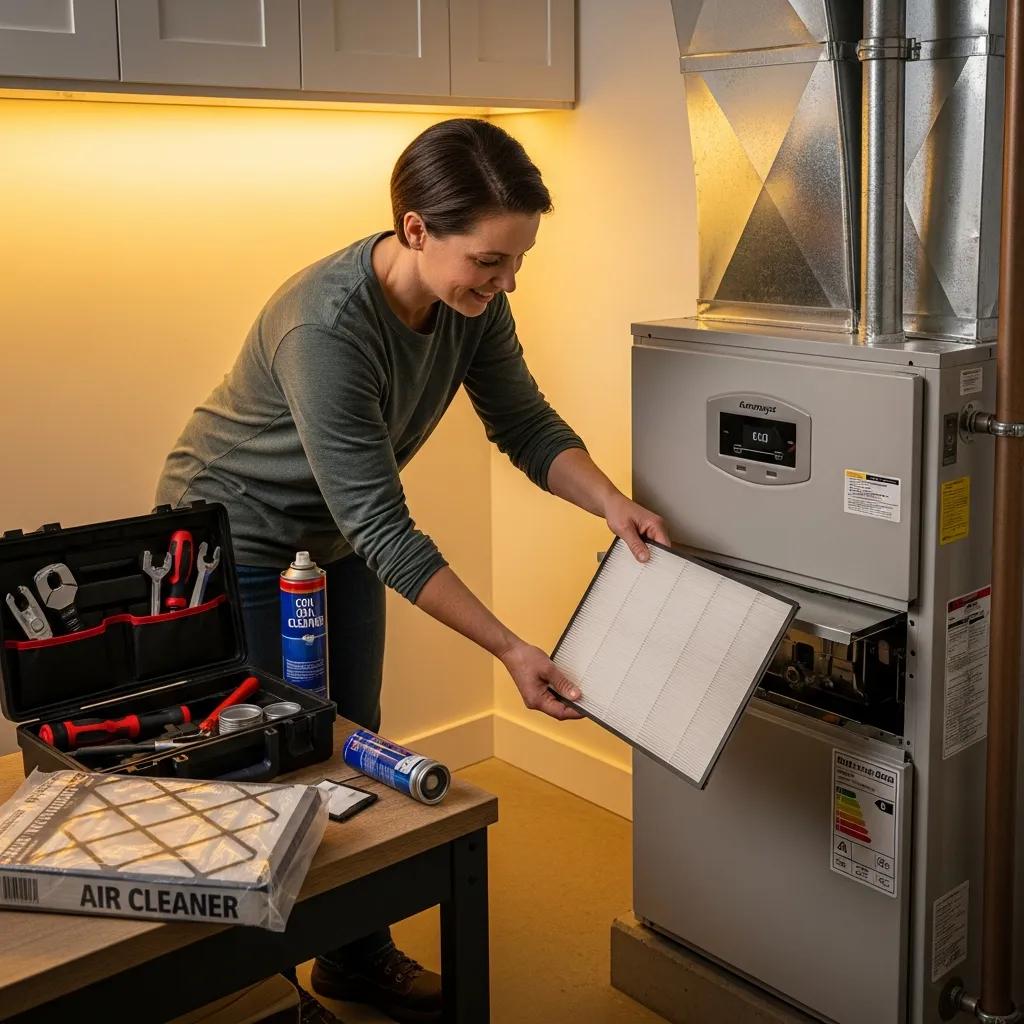
Maintaining a high-efficiency furnace preserves rated AFUE, extends equipment life, and protects warranty coverage; routine care combines homeowner tasks such as regular filter changes with an annual professional tune-up that inspects combustion, blower performance, and venting. A properly executed maintenance visit includes cleaning burners, checking heat exchanger integrity, testing combustion efficiency where applicable, lubricating motors if required, and verifying condensate drainage on condensing units. Homeowners should replace or clean filters at recommended intervals, maintain clear airflow around returns and registers, and monitor for signs of uneven heating or unusual noises that may indicate performance decline. Consistent maintenance reduces the likelihood of major repairs and supports the projected payback and lifecycle savings of a high-efficiency installation.
Implementing a structured maintenance routine ensures the system continues to deliver predicted fuel savings and reliable comfort.
What Are Recommended Annual Maintenance Practices?
Annual professional maintenance should include a full system inspection, combustion analysis if applicable, cleaning of burners and heat-exchanger surfaces, blower and motor checks, verification of venting and condensate drainage, and safety-control testing to confirm proper operation. Homeowner maintenance between annual visits should focus on timely filter replacement, keeping vents and returns unobstructed, and observing system behavior for odd noises, cycling patterns, or increases in fuel use. Document each service visit and retain receipts and maintenance logs—this helps preserve warranty coverage and demonstrates the system was cared for properly in the event of future claims. Regular maintenance not only sustains efficiency but also reduces the long-term risk of expensive repairs or premature replacement.
A combination of homeowner vigilance and annual professional care maximizes lifespan and maintains expected efficiency savings.
When Should You Consider Replacing Your High Efficiency Furnace?
Consider replacement when the furnace reaches its expected service life window, repair frequency climbs, efficiency declines noticeably, or comfort issues persist despite repairs; many high-efficiency furnaces show signs of replacement need between 15–20 years. Objective markers include rising energy bills without usage changes, uneven heating across zones, persistent mechanical failures, or a heat exchanger issue that jeopardizes safety. When major component failures would cost a significant share of a replacement, or when projected remaining life is short, replacement often becomes the more cost-effective decision. Use a repair-versus-replace checklist that weighs the expected cost of upcoming repairs, remaining service life, current efficiency, and available incentives to make an informed choice.
Timely replacement decisions prevent repeated repair bills and restore the efficiency gains that drive long-term value.
Convert to Quotes
Please provide your home details—square footage, existing fuel type, current AFUE, and any known duct or venting issues—to receive a custom, incentive-aware quote that reflects your specific installation needs and local program eligibility.
Economic Analysis of Condensing Gas Furnaces and Energy Efficiency
Condensing space and water heating equipment demonstrate 10-30 percent greater energy efficiency compared to conventional systems. Currently, condensing gas furnaces account for 40 percent of shipments and are prevalent in the Northern U.S. market. Concurrently, manufacturers are developing condensing gas storage water heaters to meet Energy Star certification requirements.
Economics of condensing gas furnaces and water heaters potential in residential single family homes, 2010